
Keeping track of the many legal proceedings relating to Western Sahara is not easy. This page offers an overview of the cases concerning the territory that have been before the Court of Justice of the European Union (CJEU).
The Polisario Front - the UN recognised representation of the people of Western Sahara - brought several actions against the EU Council before the EU courts. These actions concern EU agreements with Morocco that were applied to the Saharawi people’s occupied homeland, Western Sahara, without their consent.
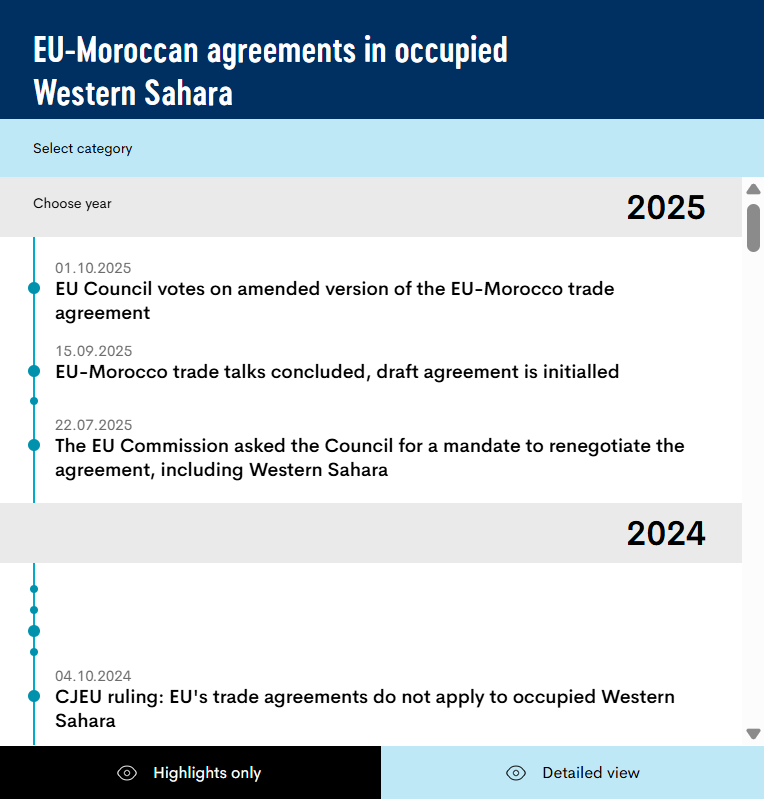
Below is an overview of the relevant cases, including ongoing proceedings, presented chronologically according to the date of the ruling(s). For each case, a short timeline is provided, along with some background, links to key-documents, and a brief explanation of the legal significance.
Ongoing cases before the General Court
The following actions brought by the Polisario Front against the EU Council are currently pending before the General Court:
- Case T-907/25 (brought 26 December 2025): seeking the annulment of Council Decision (EU) 2025/2023 of 2 October 2025, amending Protocol 4 to the EU–Morocco trade agreement as regards rules of origin and administrative cooperation, including the introduction of the concept of “region of origin” (notably “Laayoune-Sakia El Hamra” and “Dakhla-Oued Eddahab”) in place of Western Sahara as country of origin. The text of the application is available here.
- Case T-908/25 (brought 27 December 2025): seeking the annulment of Council Decision (EU) 2025/2022 of 2 October 2025 on the signing and provisional application of the EU–Morocco trade agreement. The pleas in law are identical to those raised in Case T-907/25. The text of the application is available here.
- Case T-181/26 (brought 15 March 2026): registered before the General Court. At the time of writing, only limited information is publicly available in the Court’s register.
Concluded cases brought by the Polisario Front
The following cases brought by the Polisario Front against the EU Council have been concluded. More detailed timelines are provided below.
- Case T-512/12 (brought 18 November 2012): seeking the annulment of the EU-Morocco Agriculture Agreement. The Council’s appeal against the Ruling in this case went on as C-104/16 P. (Point 1)
- Case T-180/14 (brought 14 March 2014): seeking the annulment of the EU-Morocco Fisheries Partnership Agreement. (Point 3)
- Case T-275/18 (brought 24 April 2018): seeking the annulment of the EU-Morocco Aviation Agreement. (Point 4)
- Case T-376/18 (brought 14 June 2018): seeking the annulment of the Council Decision of 16 April 2018, authorising the EU Commission to renegotiate the Fisheries Protocol with Morocco. (Point 5)
- Joined cases T-279/19, T-344/19 and T-356/19 (brought April-June 2019): challenging the 2019 EU–Morocco trade and fisheries agreements. The Commission and Council’s appeals against the Rulings went on as C-778/21 P, C-779/21 P, C-798/21 P and C-799/21 P. (Point 6)
Concluded cases not brought by the Polisario Front
Two additional cases concerning Western Sahara were referred to the CJEU by national courts.
- Case C-266/16: referred to the CJEU by the UK High Court in 2016. A year before, Western Sahara Campaign UK - a solidarity group - had brought action in the UK High Court against two British government agencies: Her Majesty’s Revenue and Customs (HRMC) and the Secretary of State for the Environment, Food and Rural Affairs (DEFRA). Western Sahara Campaign UK argued that the UK was unlawfully allowing products, originating from or processed in Western Sahara, to be imported into the country under a trade agreement with Morocco. (Point 2)
- Case C-399/22: referred to the CJEU by the French Council of State in June 2022. In October 2020, French farmers’ union Confédération Paysanne had brought action to the French Conseil d’Etat (Council of State), seeking clarifications as to whether produce from Western Sahara should be labelled as from Western Sahara, rather than from Morocco, to be in line with EU laws and regulations; and whether the French authorities have the power to prohibit imports of fruits and vegetables in case of non-compliance on rules-of-origin. (Point 7)
Key legal principles underpinning all these cases
Across its case law, the EU Court has consistently confirmed the following principles:
- Western Sahara is a non-self-governing territory, separate and distinct from the Kingdom of Morocco.
- The people of Western Sahara enjoy the right to self-determination under international law.
- Consequently, no EU-Morocco agreement may be applied to Western Sahara without the consent of the Saharawi people.
- The Polisario Front is recognised as the legitimate representative of the Saharawi people, and has standing before EU courts.
1) Case T-512/12 → Agriculture Agreement (Polisario v Council)
What:
Challenge to the EU-Morocco agriculture agreement insofar as it applied to Western Sahara.
Background:
The background to case T-512/12 lies in the progressive deepening of EU–Morocco trade relations following the entry into force of the EU-Morocco Association Agreement in March 2000, which established a free-trade area liberalising two-way trade in goods. In October 2005, the EU Council mandated the Commission to negotiate further trade liberalisation, specifically covering processed agricultural and fishery products. The Council signed the agriculture agreement (also referred to as liberalisation agreement) on 2 December 2010. The European Parliament was divided: on 12 July 2011 the European Parliament’s rapporteur in the Agriculture Committee recommended rejecting the proposed agreement, yet on 26 January 2012 the Parliament’s International Trade Committee voted in favour of it, contrary to the recommendation of its own rapporteur. During this period, on 14 February 2012, Western Sahara Resource Watch published its report Conflict Tomatoes, exposing the rapid expansion of Moroccan agricultural production in occupied Western Sahara and the export of those products to the EU. Two days later, on 16 February 2012, the European Parliament approved the EU-Morocco agriculture agreement in plenary, with 369 votes in favour, 225 against and 31 abstentions. The EU Council formally concluded the agreement on 8 March 2012, after which WSRW published a further report, Label and Liability, on 17 June 2012, documenting how products originating in Western Sahara were marketed in the EU as Moroccan. The Commission implemented the new agreement on 12 September 2012, and it ultimately entered into force on 1 October 2012.
Timeline & Key Dates:
- 19 November 2012: Polisario Front brings action (T-512/12).
- 10 December 2015: General Court annuls the agriculture agreement in so far as it applies to Western Sahara.
- 19 February 2016: Council appeals to CJEU (C-104/16 P).
- 13 September 2016: The Advocate General issues Opinion, finding that Western Sahara is not part of Morocco and is not covered by the agreement or the Association Agreement. Court press release.
- 21 December 2016: CJEU dismisses Council’s appeal. The Court confirms Western Sahara is separate and distinct from Morocco and that the people of Western Sahara are a “third party” whose consent is required, regardless of any potential benefits. (art. 106) Court press release.
Legal significance:
Established that the EU-Morocco Association and Liberalisation Agreements cannot be applied to Western Sahara without the consent of the Saharawi people, regardless of whether the agreement results in benefits for them; Western Sahara is legally “separate and distinct” from Morocco.
2) C-266/16 → Western Sahara Campaign UK v HRMC and DEFRA, referred to CJEU
What:
Ruling on the application of EU–Morocco trade and fisheries agreements to Western Sahara.
Timeline & Key Dates:
- February 2015: Western Sahara Campaign UK brings proceedings before the UK High Court.
- July 2015: hearings take place at the UK High Court.
- October 2015: UK High Court refers the case to CJEU (C-266/16).
- September 2017: CJEU hearing on the case.
- January 2018: Advocate General issues Opinion finding that the EU-Morocco Fisheries Partnership Agreement does not apply to Western Sahara.
- 27 February 2018: CJEU rules that the EU–Morocco Fisheries Partnership Agreement does not apply to Western Sahara.
- 25 March 2019: UK High Court confirms CJEU ruling, and concludes that the UK acted unlawfully in applying the agreements to Western Sahara.
Legal significance:
Reaffirmed that EU-Morocco agreements cannot apply to Western Sahara.
3) Case T-180/14 → Fisheries Protocol (Polisario v Council)
What:
Annulment of the EU-Morocco Fisheries Partnership Agreement (FPA) insofar as it applied to Western Sahara.
Background:
The events giving rise to case T-180/14 followed the rejection by the European Parliament, on 14 December 2011, of a one-year extension of the Protocol to the EU–Morocco Fisheries Partnership Agreement. Subsequently, on 5 January 2012, the European Commission requested a mandate from the EU Member States to renegotiate a fisheries protocol with Morocco. These negotiations resulted in the Commission initialling a new Fisheries Protocol on 24 July 2013, which provided for the resumption of fishing by EU vessels in the waters of Western Sahara. On 13 November 2013, the EU Council, meeting in COREPER and despite internal divisions, decided to support the proposed Protocol; Sweden, Denmark, Finland, the United Kingdom and the Netherlands did not support the deal. The process continued with the European Parliament voting in favour of the new EU–Morocco Fisheries Protocol on 10 December 2013, followed by the formal conclusion of the Protocol by the EU Council on 16 December 2013, setting out the fishing opportunities and financial contribution under the Fisheries Partnership Agreement between the European Union and the Kingdom of Morocco.
Timeline & Key Dates:
- 14 Mar 2014: Polisario initiates case T-180/14.
- 15 Jul 2014: New FPA Protocol enters into force.
- 19 Jul 2018: CJEU judgment holds FPA Protocol inapplicable to Western Sahara.
Legal significance:
Confirmed the same principles from T-512/12 now applied to fisheries: no inclusion of Western Sahara without Saharawi consent, regardless of potential benefits to the Saharawis.
4) Case T-275/18 → Aviation Agreement (Polisario v Council)
What:
Challenge to the EU-Morocco aviation agreement’s territorial scope.
Background:
The background to case T-275/18 lies in the Aviation Agreement between the European Union and the Kingdom of Morocco, which entered into force in December 2006. In February 2014, the European Commission proposed an amendment to that Agreement in order to take account of changes within the European Union, in particular the accession of three new Member States since 2006 and the institutional changes brought about by the entry into force of the Lisbon Treaty. The amended version of the Agreement was subsequently approved by the European Parliament in October 2017 and was formally concluded by the Council in January 2018.
Timeline & Key Dates:
- 24 April 2018: Action filed (T-275/18).
- 30 November 2018: CJEU declares the aviation deal invalid insofar as it is applied to Western Sahara.
- 6 March 2020: EU Commission confirms Western Sahara is not covered by any aviation agreement.
Legal significance:
Extended the principles established in cases T-512/12 and T-180/14 to the EU-Morocco aviation agreement: affirms Morocco’s lack of sovereignty over Western Sahara, that including the territory in the agreement infringes on the principle of self-determination, and that the EU cannot “validly share an intention of the Kingdom of Morocco to include the territory in question in the area of application of the Agreement" (art. 33).*
5) Case T-376/18 → Fish Negotiations (Polisario v Council)
What:
Challenge to Council decision authorising Commission negotiations with Morocco for a new Fisheries Agreement.
Background:
In February 2018, the Court of Justice of the European Union concluded that the EU-Morocco Fisheries Partnership Agreement cannot be applied to Western Sahara, as that territory does not fall under Moroccan “sovereignty or “jurisdiction”, and is not part of “Moroccan fishing zones” – a notion used throughout the Agreement and its implementing Protocols (Case C-266/16, forwarded by the UK High Court). On 16 April 2018, the Council authorized the Commission to open negotiations with Morocco for a modification of the territorial scope of the Fisheries Partnership Agreement (so as to include Western Sahara) and for the conclusion of a new Fisheries Protocol. In July 2018, the CJEU confirmed the EU-Morocco FPA inapplicable to Western Sahara in its conclusions in case T-180/14, brought by the Polisario Front.
Timeline & Key Dates
- 14 June 2018: Polisario brings action.
- 8 February 2019: Court declares request inadmissible as it was too early to assume Council’s intentions vis-à-vis Western Sahara, but reaffirms the Saharawi people’s rights and third-party status.
Legal significance:
Reaffirms Saharawi people’s right to self-determination and their status as a third party to EU-Morocco agreements under international law.
6) Joined Cases T-279/19, T-344/19 & T-356/19 → 2019 Trade & Fisheries Agreements (Polisario v Council)
What:
Annulment actions against the 2019 EU-Morocco trade (T-279/19) and Sustainable Fisheries Partnership Agreement (SFPA) (T-344/19 and T-356/19) as applied to Western Sahara.
Background:
On 29 May 2017, the EU Council mandated the Commission to renegotiate the trade agreement with Morocco, after the CJEU had concluded it inapplicable to Western Sahara, first in 2015 (General Court, T-512/12) and again in December 2016 (CJEU, C-104/16 P). On 31 January 2018, the Commission initialled a new deal with Morocco covering trade in goods from Western Sahara, without seeking or obtaining the consent of the Saharawi people. In the months that followed, the EU Commission and European External Action Service (EEAS) conducted a consultation process involving Moroccan politicians, businesses and associations that supported the agreement. However, the list of consulted stakeholders submitted to the Council and Parliament, also included nearly 100 Saharawi and EU civil society organisations that had not participated in the consultation, including WSRW. Despite lacking Saharawi consent, as required by the CJEU, Council approved the new agreement in July 2018. In September 2018, the EU Parliament’s Legal Service issued a legal opinion stating that it was unclear whether the proposed agreement aligned with the Court’s ruling in case C-104/16 P. That same month, the Parliament conducted a 2-day fact-finding mission to the territory, which did not report on any technical or legal issues, and primarily involved meetings with Moroccan businesses. Three months later, it emerged that the Parliament’s Rapporteur on the file, who had led the fact-finding mission, was on the board of a pro-Morocco lobby group. She resigns in December 2018. Nevertheless, her report to Parliament - calling for a vote in favour of the new agreement - was not withdrawn. Although a newly appointed Rapporteur subsequently called on Parliament to seek legal advice from the Court of Justice, this request was not supported. Parliament ultimately voted in favour of the proposed deal on 16 January 2018. Please read our report “Above the law” of December 2020 for further details on these developments.
Timeline & Key Dates:
- 27 April 2019: Polisario brings proceedings, seeking the annulment of Council Decision 2019/217 of 28 January 2019 on concluding the amendments to the Protocols to the Euro-Mediterranean Agreement establishing an association between the European Communities and their Member States, of the one part, and the Kingdom of Morocco, on the other part. (Case T-279/19).
- 10 June 2019: Polisario brings action against the Council, seeking the annulment of Council Decision 2019/441 of 4 March 2019 on the conclusion of the EU-Morocco Sustainable Fisheries Partnership Agreement, the Implementation Protocol thereto and the Exchange of Letters accompanying the Agreement. (Case T-344/19)
- 12 June 2019: Polisario brings action against the Council, seeking the annulment of Council Regulation 2019/440 of 29 November 2018, allocating the fishing opportunities under the newly concluded Sustainable Fisheries Partnership Agreement and Protocol. (Case T-356/19)
- The Court joins these three cases.
- 2-3 March 2021: Hearing before the General Court.
- 29 September 2021: General Court judgments annul both the trade and fisheries instruments insofar as they apply to Western Sahara. The Court issued a ruling in cases T‑344/19 et T‑356/19 (on fisheries) and a ruling in case T-279/19 (on trade). The Court’s press release accompanying the rulings can be accessed here.
Legal significance:
Reaffirms Polisario’s legal personality as internationally recognised representative of the people of Western Sahara; reaffirms the separate and distinct status of Western Sahara from Morocco; reaffirms that the people of Western Sahara ought to consent to extending the agreement to the territory; stipulates that consultations of the local population carried out by the EU institutions cannot substitute the consent of the people.
Appeals:
- 14 December 2021: Commission lodges appeals against the ruling nullifying the EU-Morocco trade deal in Western Sahara (C-779/21 P) and against the ruling nullifying the EU-Morocco Fisheries Agreement in the territory (C-778/21 P).
- 16 December 2021: Council lodges appeals against the ruling on the trade agreement (C-799/21 P) and against the ruling on the fisheries agreement (C-798/21 P).
- 23-24 October 2023: CJEU hears parties to the cases.
- 4 October 2024: CJEU (Grand Chamber) rulings dismiss all appeals and uphold the 2021 annulments. The ruling on the trade agreement (C-779/21 P and C-799/21 P) can be found here, the ruling on the fisheries agreement (C-778/21 P and C-798/21 P) can be found here. The Court’s press release can be read here.
Legal significance:
The Court has firmly established the position of Front Polisario to be able to bring cases on behalf of the Saharawi people, and that it has access to the EU Courts to defend their right to self-determination. The Court has confirmed the separate and distinct status of Western Sahara. The Court has unambiguously stated that the “population of Western Sahara” and the “people of Western Sahara” are not the same thing. The consultation process conducted by EEAS and Commission can therefore not be equivalent to obtaining the consent of the people of the non-self-governing territory of Western Sahara. The Court adds that consent can be explicit, but may also be presumed under very strict conditions, aimed at preserving the right to self-determination and independence.
7) C-399/22 → Confédération Paysanne v French Ministry for Agriculture and Ministry for Economy, referred to CJEU
- October 2020: French farmers’ union Confédération Paysanne brings action to the French Conseil d’Etat (Council of State), seeking clarifications as to whether produce from Western Sahara should be labelled as from Western Sahara, rather than from Morocco, to be in line with EU laws and regulations; and whether the French authorities have the power to prohibit imports of fruits and vegetables in case of non-compliance on rules-of-origin.
- June 2022: The French Council of State refers the case to the EU Court of Justice in June 2022 (case C-399/22).
- 4 October 2024: EU Court of Justice rules that products from Western Sahara on the EU market should be labelled as from Western Sahara, and not “from Morocco”.
Legal significance:
Reiterates that Western Sahara is separate and distinct from Morocco and is a customs territory within the meaning of EU law. The indication of the country of origin on produce from the territory may designate only Western Sahara, as any other indication is misleading to consumers.

This is what the ECJ said on trade in Western Sahara
WSRW has summarised the key findings of the landmark rulings on Western Sahara of the EU Court of Justice, of 4 October 2024.

African Court rules for Saharawis
The African Court on Human and Peoples’ Rights concludes Morocco's occupation of Western Sahara to be a serious violation of the Saharawi people’s right to self-determination and independence.

Morocco proposes jurist for non-jurist UN body
In the middle of Moroccan-Spanish maritime disputes offshore Western Sahara, Morocco is lobbying for a defender of the occupation of Western Sahara to sit at an important UN scientific body for maritime continental boundaries.

Enel failed the test
The Italian company Enel is one of the firms that have taken the exact same approach as the EU when carrying out ‘stakeholder consultations' in Western Sahara - a procedure now found invalid by the EU Court of Justice.